Showing posts with label Year 2 Term 2. Show all posts
Showing posts with label Year 2 Term 2. Show all posts
Thursday, 18 February 2010
relational aesthetics/ antagonism and relational aesthetics etc
Ben Lewis made a BBC film Art Safari - Relational Art: Is It An Ism? looking at various artists mentioned in Nicolas Bourriaud's Relational Aesthetics. You can watch it here. An interview about it is here.

Tuesday, 9 February 2010
Tim Head
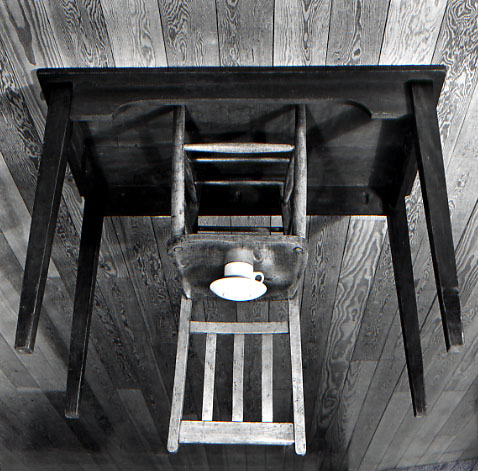
Levity 1 1978,
lev·i·ty (l v
v
 -t
-t )
)
v-t)n. pl. lev·i·ties
1. Lightness of manner or speech, especially when inappropriate; frivolity.
2. Inconstancy; changeableness.
3. The state or quality of being light; buoyancy.
I like the playfulness of this work which I think exists as a photograph rather than being a photograph of an installation. By using everyday objects familiar to the viewer you can enter into the work and read it through your knowledge of object, mass, gravity, balance etc.
Sunday, 31 January 2010
Christine Hill
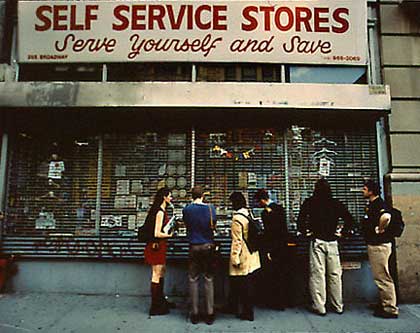
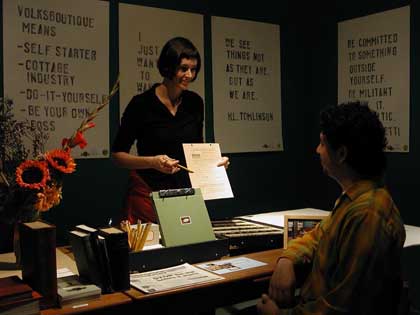
Works such as Volksboutique and Tour Guide? (1999) combine a performative element along with the artist providing a service and thereby gaining an audience in that way whilst also questioning the artist's role in society.
This idea of merging income and art occupations culminated with opening the Volksboutique-as-shop in 1996. It was a way of claiming autonomy. It both freed me from being anyone's employee, and launched me straight into Proprietor-status, and it absolved me from having to rely on the art system to provide me with an audience. It allowed me to build a base of operations, and work from it, which is a device I've held onto over years.
Really intersesting interview with Christine Hill here.
I'm also curious about her work which uses a kind of documentation of her work and life and which then becomes the work itself for example Minutes (2007 Venice Bienalle).
Initially, I thought of this book as a sort of end of year Annual Report, and was thinking of course about summing up.
"It is entitled Minutes (as is the entire piece for Venice) — referring to detail, minutae; the passing and accruing of time; and of course, taking meeting minutes, the tallying of progress.
The book as an object is patterned after a calendar/datebook. In considering what one could/should put in an exhibition like Venice, there seemed to be pressure for Big Project, and I sort of dislike the notion of the masterpiece or opus. I like the continuum, that the machine is humming, that things are ebbing and flowing insofar as industry is concerned, and that many factors contribute to the so-called Process. This is most easily evidenced by a glimpse into my own datebook. So, the piece for Venice speaks to that...how my (or the mind) is organized, and what things are in there, and they can be very small things, and that it is something about growth via accumulation. And organization. I like that haircut appointments reside in the same space as big deadlines, and so-called Events of Note."
Insight into Hill's view of her notebooks and work for Minutes "they illustrate my method of ordering and apportioning time and energy ‹ specifically addressing how my labor is divided between my daily life, my artmaking, and my responsibilities as a professor. These lists, these tallies, the organization of details in setting up projects start to become their own project. "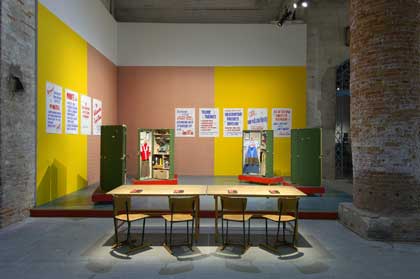
Nicolas Bourriaud, Relational Aesthetics
Some interesting definitions from the glossary of Nicolas Bourriaud's Relational Aesthetics, 1998
Aesthetic theory consisting in judging artworks on the basis of the inter-human relations which they represent, produce or prompt.
Relational (art)
A set of artistic practices which take as their theoretical and practical point of departure the whole of human relations and their social context, rather than an independent and private space.
Co-existence criterion
All works of are produce a model of sociability, which transposes reality or might be conveyed in it. So there is a question we are entitled to ask in front of any aesthetic production: "Does this work permit me to enter into dialogue? Could I exist, and how, in the space it defines?" A form is more or less democratic. May I simply remind you, for the record, that the forms produced by the art of totalitarian regimes are peremptory and closed in on themselves (particularly through their stress on symmetry). Otherwise put, they do not give the viewer a chance to complement them."
Thursday, 28 January 2010
Sophie Calle
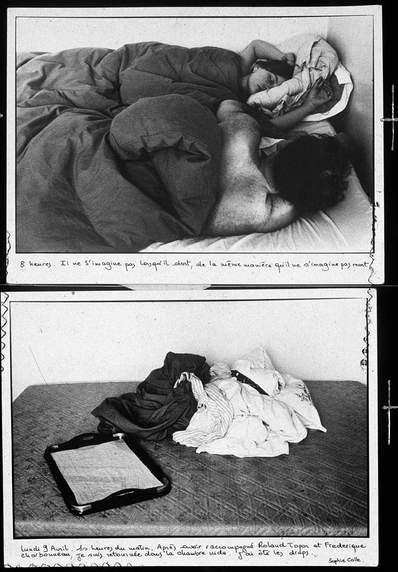

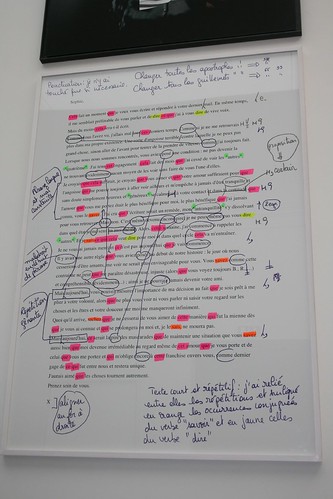
Link to Guardian article.
examining human behaviour
differences between public lives and private selves
process of investigation and documentation
rules or constraints which create the work (following people, Address Book, Take Care of Yourself etc.)
who is in control of the work?
Sleepers (1980)
Take Care of Yourself (2007)
Gordon Matta-Clark
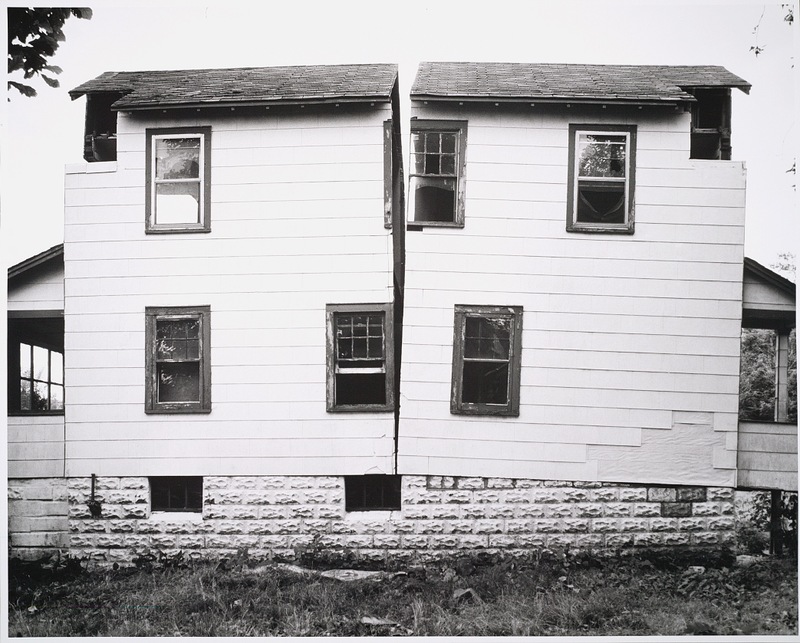
Splitting, 1974
The impact that Gordon Matta-Clark's work has is incredible. He forces you to really look, to see something you thought you were familiar with in a completely new way, he plays with perceptions. Each "building cut" work seems to have been approached with a very clear decision which creates a monumental work. The actions have a violence and deliberateness but also a playfulness. The physical labour of the construction (deconstruction?) creates challenges both in the process of making and in viewing. (And the idea that most of these works were demolished soon after completion.) It is the physicality of the building cuts that makes them so amazing to me - a sense of disbelief and enchantment at seeing something so structural changed so dramatically.
Link to New York Times review of retrospective in Whitney Museum of American Art.
Subscribe to:
Comments (Atom)