Sunday, 31 January 2010
starter
Starters, not something you eat before your main course, I'm thinking about sourdough starters. A combination of flour and water (or fruit juice etc.) which contains a stable symbiotic culture of bacteria and yeast. The aim is that the yeast already present on the flour is allowed to grow and bacteria such as lactobacillus also develop in the starter and then it is used as the leavening agent in sourdough recipes. The starter is "grown" and then "fed" and if you keep it right and like the flavour it creates a starter can survive generations. I have only just started my starter so it will be at least a week before I can try it out.

Thursday, 28 January 2010
Sophie Calle
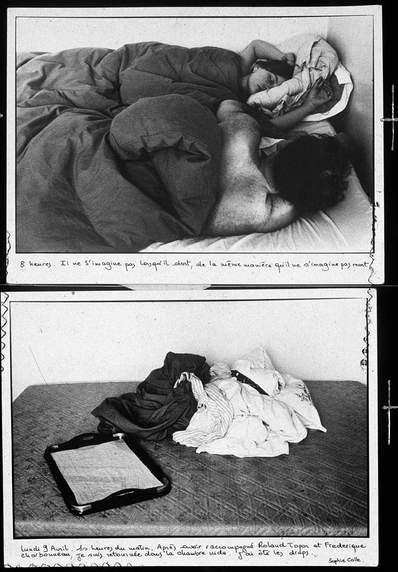

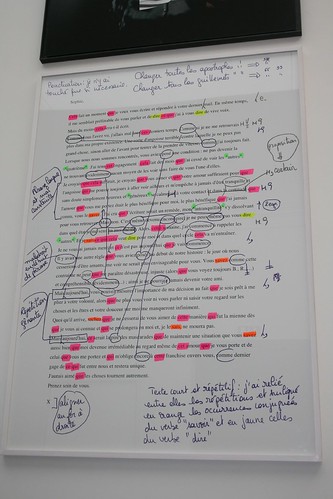
Link to Guardian article.
examining human behaviour
differences between public lives and private selves
process of investigation and documentation
rules or constraints which create the work (following people, Address Book, Take Care of Yourself etc.)
who is in control of the work?
Sleepers (1980)
Take Care of Yourself (2007)
Gordon Matta-Clark
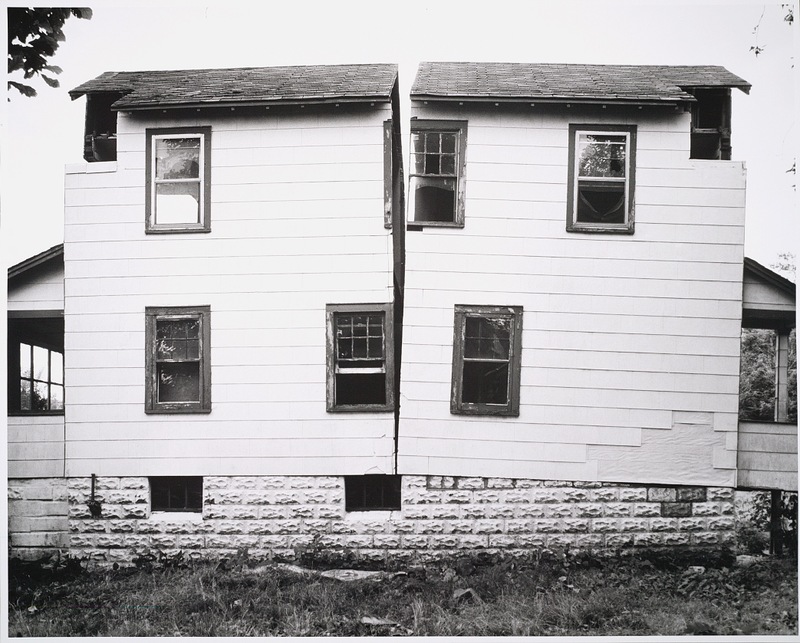
Splitting, 1974
The impact that Gordon Matta-Clark's work has is incredible. He forces you to really look, to see something you thought you were familiar with in a completely new way, he plays with perceptions. Each "building cut" work seems to have been approached with a very clear decision which creates a monumental work. The actions have a violence and deliberateness but also a playfulness. The physical labour of the construction (deconstruction?) creates challenges both in the process of making and in viewing. (And the idea that most of these works were demolished soon after completion.) It is the physicality of the building cuts that makes them so amazing to me - a sense of disbelief and enchantment at seeing something so structural changed so dramatically.
Link to New York Times review of retrospective in Whitney Museum of American Art.
Tuesday, 12 May 2009

Gary Hill
Tall Ships
"Enter a long dark corridor, like a narrow harbour, and encounter a fleet of twelve human figures like tall ships adrift in space. They are the only source of light, their faces like white sails in the moonlight. Like the spectral figures in Dante’s Purgatorio, or the sirens in Homer’s Odyssey, these phantoms stand silently, waiting, until you enter and disturb the fragile peace. As you journey into the stillness of this space, sensors are triggered and the nearest figure will move closer. Each apparition, whether man, woman or child, offers itself to you as if about to speak. Yet they stand, shimmering and silent, until they turn away, unable to unburden the secrets hidden behind their eyes. This fleeting moment leaves an unearthly, haunting sensation. Do we ever really connect, or are we just passing ships in the night?American artist Gary Hill first exhibited Tall Ships in the early 1990s as he rose to prominence as one of the world’s pre-eminent video artists. While Hill has explored interactive encounters between life-size video imagery and exhibition visitors in other works, Tall Ships is considered to be the most profoundly immersive experience in his body of work. In the artwork, Hill allows his video art to move toward an expression of the intangible sensations that tingle on the surface of the skin, and linger in the dark recesses of our hearts and minds.
Tall Ships transports us from the real world, crossing into an unfamiliar world of experience where we discover lost friends and dream-like figures. Visitors to the deep spaces of Hill’s work transcend physical movement through the installation into darker, uncharted waters. Into the space of emotions, intuition and ghostly sensations. Into the space of premonitions, memories and dreams."
"...That person, however vulnerable, will come forth no matter
what. It’s the simplicity of the idea - humans approaching humans in a space of a work that is
always slightly haunted by the notion of “ships passing in the night.”
Sunday, 10 May 2009
identical twins
Take 10 Identical Twins from the guardian online


Right- Me and Katie at the 'Muchty festival when we were about 4 (from the local newspaper)
Friday, 8 May 2009
some of the things I've been looking at
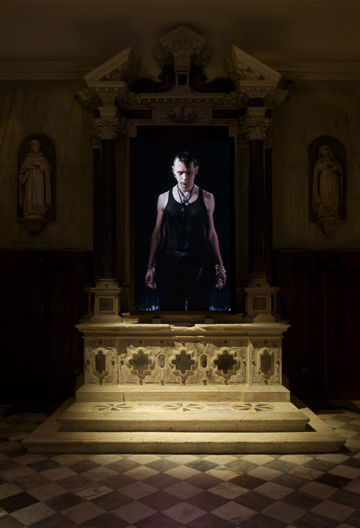

 Bill Viola
Ocean Without a Shore, 2007
Using a mix of the oldest, black and white surveillance filming and the newest HD cameras with a sheet of pouring water the person begins in black and white then breaks through the water barrier into full colour and detail.
The Reflecting Pool, 1977
Playing with the reflections in the pool and the tension/suspense of a person jumping and being frozen in mid air- suspended above the water. Then the activity continues only in the reflection and eventually a person does emerge again from the water.


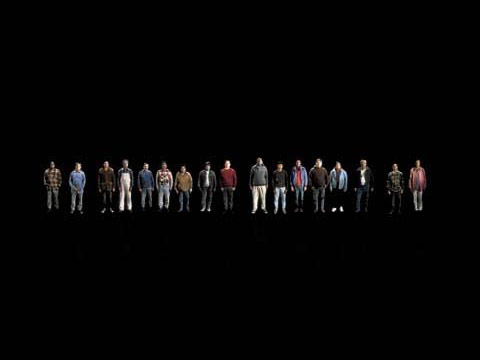
Viewer
People watching, people watching, Who is watching, who is being watched..
Threshold to the Kingdom, 2000
Filming international arrivals at the airport, slowed down as people move through the doors an d then as doors in the background close the image fades into the next group of people entering, Links between Customs and the emotions or judgement people have there with the religious idea of Confession,
Filmed himself reading religious scripture backwards while treading on the bottom of escalators in the underground. The whole film is then played in reverse so that the words are fairly audible but distorted. Ends with him "floating" back up the escalators as if going to heaven.
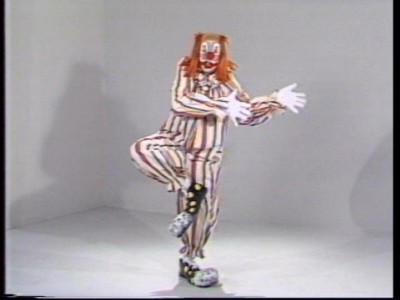
Dance or Exercise on the Perimeter of a Square (Square Dance) 1967
Some other studio experiments
"Nauman's "Clown Torture" is a shattering spectacle of color, motion, and sound. Displayed at high volume, the audio level of the five simultaneously occurring videos is an assault on the senses. Heard long before it's viewed, one must bravely enter into an enclosed, darkened room in order to see where all the noise is coming from. Once inside, two pairs of stacked monitors and two wall projections come into view. Immediately one senses that something is awry, as only two of the four televisions are oriented right side up. With one monitor turned upside-down and the other placed on its side, the images become abstracted and disorienting. The videos playing on the monitors record clowns in unnerving or difficult situations. In one sequence, a clown screamsat an unseen antagonist. In another, a clown repeats the elliptical story "Pete and Repeat were sitting on a fence. Pete fell off; who was left? Repeat. Pete and Repeat were sitting on a fence." Recited with a variety of expressions (happy, scared, mad, etc.), the clown can't help but hide a growing frustration at not being able to finish the story or have it make sense. Two videos show clowns trying balance objects - goldfish bowls and buckets of water - with little success. The final video resembles a scene from a closed-circuit security camera, only it's a disconcerting image of a clown using a public toilet.
Nauman's "Clown Torture" makes its artifice obvious, from the caked makeup of the clowns' faces to the many power cords that run across the ceiling, walls, and floor. With activity occurring from nearly every angle, the viewer - like the clown - is the subject of experimentation and interrogation. While it's easy to tell that these clowns are only acting-out traumas, it is nevertheless difficult to watch and purposefully so. "Clown Torture" makes the viewer question his or her own participation in the events on screen. Alluding to difficult subjects such as insanity, political torture, and surveillance, the work makes complex connections between theater, media, and apathy The makeup, hair, and costume of each clown act as a disguise for the actor or person underneath. Anonymous victims and inciters of brutality and pranks, these scared and scary clowns seem simultaneously real and unreal."
Nauman's "Clown Torture" makes its artifice obvious, from the caked makeup of the clowns' faces to the many power cords that run across the ceiling, walls, and floor. With activity occurring from nearly every angle, the viewer - like the clown - is the subject of experimentation and interrogation. While it's easy to tell that these clowns are only acting-out traumas, it is nevertheless difficult to watch and purposefully so. "Clown Torture" makes the viewer question his or her own participation in the events on screen. Alluding to difficult subjects such as insanity, political torture, and surveillance, the work makes complex connections between theater, media, and apathy The makeup, hair, and costume of each clown act as a disguise for the actor or person underneath. Anonymous victims and inciters of brutality and pranks, these scared and scary clowns seem simultaneously real and unreal."
Subscribe to:
Posts (Atom)